An address and two key poems
In 1902 Lepeshinsky, an agent of Lenin’s newspaper Iskra, asked its editors for Lenin’s address in a letter ending in pairs of numbers. The reply says “our personal address”, then gives none. An agent and the editors shared a poem, the key, and wrote secrets as pairs of numbers naming a line and a letter in it.
Soviet scholars printed both in 1969–70 without deciphering the pairs. Counted as the journal Zarya printed it, the hymn that was Lepeshinsky’s key turns them into Lenin’s London address. The scholars deciphered a letter of 1901 sending Ivan Babushkin to “the man from abroad”, but gave no key. Tried as its key, a Russian translation of an Italian poem gives 16 of 18 letters of their reading. Where they printed dots, it gives what may be a name, Iodello. The cipher historian Sinelnikov rebuilt most of the agent Bauman’s key, a square cut from a poem. Its first two rows lead to the poem, which fits 64 of 69 filled cells elsewhere.
In the spring of 1902 Panteleimon Lepeshinsky wrote from Pskov to the editors of Iskra, the newspaper Lenin and his comrades printed abroad and smuggled into Russia. Lepeshinsky was one of its agents. He needed to know where to find Lenin and his wife, Nadezhda Krupskaya, since he meant to come abroad with her mother, Elizaveta Vasilyevna. «Сообщите, дорогие друзья, ваш личный адрес, куда к вам держать путь» (let us have your personal address, dear friends, so that we know where to make for), he wrote, and a few lines on, «Только поспешите с адресом» (only be quick with the address). Three lines of number pairs follow in the same paragraph, beginning 10.2 2.2 1.6 2.5 11.4 2.3.
Krupskaya, who kept the editors’ letters, answered from London on 6 June. They would be very glad to see him, she wrote, and then «Наш личный адрес» (our personal address), with nothing after it. He should telegraph so that someone could meet him, and if anything went wrong with the telegram he should take a cab, give the driver the address written on a slip of paper and knock at the door twice.
Both letters are in the Soviet edition of the correspondence between Iskra’s editors and its agents, published in three volumes in 1969 and 1970. Its compilers printed Lepeshinsky’s pairs without a reading. In a note to Krupskaya’s reply, the next document in the volume, they wrote that the address was missing, «вероятно J. Richter’a» (probably J. Richter’s).Lepeshinsky’s letter is no. 449 in vol. 2, and Krupskaya’s reply no. 450, pp. 11–12. A. V. Sinelnikov’s study of the Russian revolutionaries’ ciphers, written in 1980–2000 and revised in 2009, lists these pairs among the passages still unread. The study names the poem that reads the other ciphered words in Lepeshinsky’s letter, and notes that it “does not fit here”. With its lines counted as they were printed, the poem turns the pairs into a name and an address in London (Figure 1):
Якоб Рихтер, Холфорд-сквер 30, Пентонвил, Лондон В. С.
Jacob Richter was the name Lenin used in London, and 30 Holford Square the house where he and Krupskaya had lodged since April. As the edition prints it, the letter that asks for the address ends with it, and the edition does not say whose hand wrote the pairs.The index of the edition gives both under «Richter J.», and Lenin sent the address in plain words to P. B. Axelrod on 23 April 1902: “Mr. Jacob Richter (Holford) 30. Holford Square. Pentonville. London W. C.” Between the 40 pairs at the end of the letter stand three signs written in clear, that is, as themselves: the Ф of «Холфорд», since the hymn has no ф, a dash and the 30. The Ф of «Уфу» among the seven names is written in clear as well. The cipher spells «Пентонвил» with one л, and W. C. as the Russian letters В and С. Sinelnikov’s figure of 43 pairs is highly likely to count them as well. The first two pairs, 10.2 and 2.2, give и and а. They may be nulls, put in only to mislead, of the kind Lepeshinsky and Krupskaya were both using that spring. They do not fall under the rule Krupskaya sent another agent in June, that every pair with a second number above 16 was a null, and nothing shows what they are.
The secret parts of these letters were in cipher because the post was read. Across Russia, officials in secret offices known as black cabinets opened and copied letters, and at the Police Department I. A. Zybin and a pupil of his deciphered the copies. In February 1902 the police arrested Iskra’s agents across Russia. In June Krupskaya wrote to a comrade of «разгром страшный» (a terrible rout), with a mass of people taken, the printing press lost and every route for carrying the paper broken.Sinelnikov, pp. 107, 130, 135, 137, 141, 147 and 196. Zybin’s pupil was S. I. Zhabchinsky. The agents wrote in invisible ink between the lines of a harmless letter, and put the most secret lines into cipher as well. Krupskaya’s words: «Разгром страшный, у нас взята масса людей, типография, провалились все транспортные пути».
Two letters written on 5 April 1901, a year before Lepeshinsky’s, concern N. E. Bauman, Iskra’s agent in Moscow. One told Ivan Babushkin, another agent, how to find Bauman. Its key is not in the edition. The other went to Bauman in his own key, a poem that three researchers each looked for over many years.
Not as in “The Gold-Bug”
Lepeshinsky remembered in his memoirs that each agent wrote to Krupskaya in a separate cipher, «не постоянных знаков для букв, как у Эдгара По в рассказе «Золотой жук», а переменных» (with signs for the letters not constant, as in Edgar Poe’s story “The Gold-Bug”, but variable).Lepeshinsky, На повороте (Moscow, 1955), p. 134, quoted by Sinelnikov, p. 130. An agent and the editors agreed in advance on a poem. They wrote each letter of a message as two numbers, which gave a line of the poem and the letter’s place in that line.The edition prints the pairs with a point in some documents and as a fraction, 15/3, in others, and they are quoted here as it prints them. Proposing a book cipher of its own in June 1902, the Kharkov committee set out the rule for the fraction: «числитель обозначает строку сверху, знаменатель — букву от левой стороны» (the numerator stands for the line from the top, the denominator for the letter from the left; vol. 2, no. 463). Spaces and punctuation are not counted. Lepeshinsky’s poem was a satirical hymn, and he dropped its first line, so that line 1 is the hymn’s second, «Темныя силы въ загривокъ насъ бьютъ» (dark forces strike us on the scruff of the neck). Its sixth letter is я, so я can be written 1.6. The fifth letter of line 2 is к, the fourth of line 11 is о and the third of line 2 is б, and so the pairs 1.6 2.5 11.4 2.3 spell якоб, the first name of the address.
A letter stands in many places in a poem, and the encipherer chose one each time (Figure 2). In this key о stands in 81 places and е in 70, counting the old letter ѣ as е.In practice the encipherers mostly took the first place of a letter in a line they chose: 35 of the 38 letters of the address, 36 of the 38 in the seven names of Lepeshinsky’s letter and 29 of the 31 complete pairs of the letter to Babushkin stand at the first place of their letter in their line. That leaves о 31 lines rather than 81 places, and keeps the second numbers small. Poe’s hero reads a pirate’s message by counting its signs and taking the commonest for the commonest letter. Here the commonest Russian letter, о, is spread over dozens of signs.
The first line is not counted, and line 1 is the second. The refrain is indented and the lines are numbered as the journal Zarya prints them (Figure 3); Lepeshinsky’s own numbers run behind from line 11 (Figure 4). In writing, ѣ stands for е and і for и, and a letter the poem lacks, such as ф, stays in clear, as itself. Underlined: the letters the pairs give. Shaded: the places of one letter of the text, at rest о.
The pairs read якоб. Shaded: the 81 places that hold о, any of which would do for it.
The weakness was the poem. Before Lenin left Russia in 1900 he set the first agents’ keys himself, all of them poems everyone knew: Nadson for the Pskov group, Lermontov for Nizhny Novgorod, Nekrasov for Babushkin’s group at Smolensk.Sinelnikov, pp. 130–132. Sinelnikov’s reasons for poems: they left nothing incriminating to carry, the table was ready-made, a key could be named in a letter in one word, and the classics could be found anywhere. A decipherer with the popular poets on the desk could try them one by one, and Zybin had the officers who made arrests look through their prisoners’ books for any that might be a key. In May 1903 Zybin reported that the more experienced revolutionaries, the Iskra group among them, had turned to new kinds of key, among them pages of little-known books.Sinelnikov, p. 107, after T. A. Soboleva. The memo names double keys as well.
Forward, more slowly
The hymn is «Гимнъ новѣйшаго русскаго соціалиста» (Hymn of the newest Russian socialist), a parody by Yuli Martov, one of Iskra’s editors. Martov signed it Narcissus Tuporylov (roughly Narcissus Blunt-snout). The Iskra group’s journal, Zarya, printed it in its first number, in April 1901. The hymn mocks the Economists, who wanted the workers to press for wages before politics, by speaking in their voice. Each stanza closes on a refrain of four short lines, and the first refrain ends on these two: «Тише впередъ, / Рабочій народъ!» (forward, more slowly, working people!). The ъ that ends both lines is the hard sign. Until the reform of 1918 it was written, without a sound, after most words that end in a consonant, and in a key it counts as a letter of the line, so a copy of the poem in modern spelling gives different numbers.The hymn goes to the tune of the Varshavianka, a revolutionary song whose refrain ends «Марш, марш вперёд, / Рабочий народ!» (march, march forward, working people!).
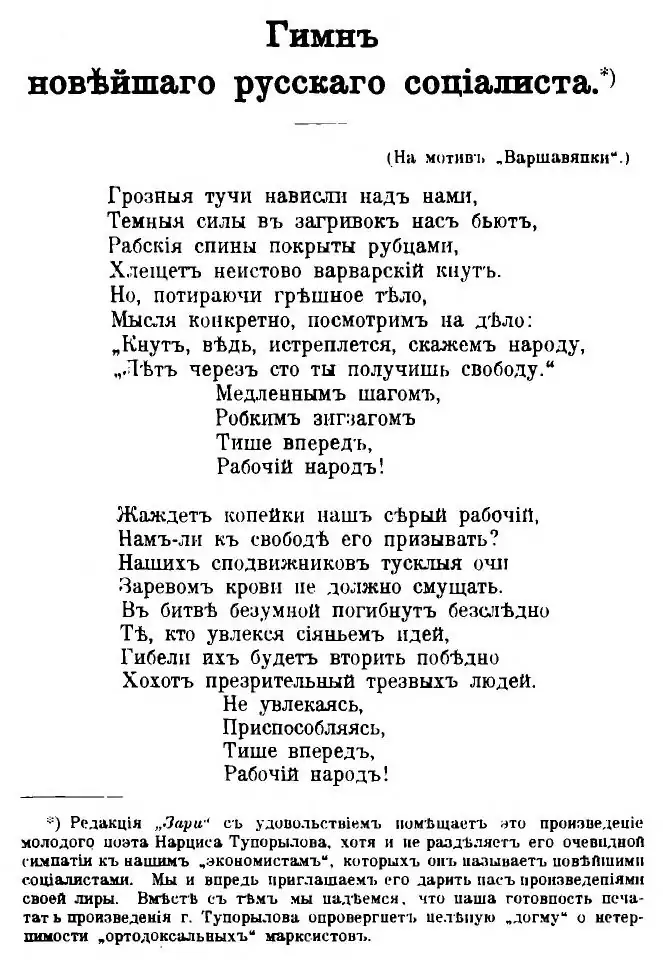
The hymn was the key Inna Leman used with the editors. She had been their secretary and was by then an agent in Russia, and in January 1902 she told them that Lepeshinsky would take it over, counting from its second line.The edition, vol. 1, no. 304, p. 383: he «будет считать не с первой строки, а со второй, первую строку совсем отбросить» (will count not from the first line but from the second, and drop the first line altogether). Lepeshinsky appears there as “2а3б”, whom the index identifies. Sinelnikov names the hymn as the key of five letters between Leman and the editors, vol. 1, nos 268, 277, 279, 287 and 299. In three of them, nos 268, 287 and 299, the compilers read passages without naming the key; the passage in no. 277 is printed as Krupskaya deciphered it, apart from a surname the compilers read; and no. 279 is the police copy described next. By then the police had a copy of a letter that Krupskaya had sent Leman in December, enciphered with the hymn, and according to Sinelnikov they were soon able to read it.The edition, vol. 1, no. 279, pp. 346–347, printed from the police copy, with the words in cipher as the Police Department deciphered them. Sinelnikov, p. 145. Lepeshinsky’s letter from Pskov has seven names in cipher besides the pairs at its end, and Krupskaya deciphered them when it came.In English, Olga Borisovna, Zhorzh, Varde, Elizaveta Vasilyevna (Krupskaya’s mother), Gorn, Noskov and the town of Ufa. Olga Borisovna is Lepeshinsky’s wife, Olga Lepeshinskaya, who had done the Pskov group’s enciphering. Sinelnikov found that Lepeshinsky took the two short lines «Тише впередъ, / Рабочій народъ!» as one, in both refrains that end on them, so that his line numbers fell first one and then two behind the journal’s. Lepeshinsky, Sinelnikov concluded, had worked from a handwritten copy of the hymn.
Lepeshinsky’s count reads all seven names, letter for letter.Five spare pairs stand among the names’ letters, and point at a hard sign or past the end of a line. Sinelnikov calls the three in the name of Ufa nulls, pairs that stand for nothing and are put in to mislead. Sinelnikov’s word is «фиктивные дроби» (fictitious fractions), and the study reports that Lepeshinsky had begun to put them into his cipher in 1902.
Lepeshinsky’s count reads all seven names in his letter. Of the 38 letters of the address, how many does the same count get right? Pick one before Figure 4 shows it.
Lepeshinsky’s count gets 19 of the address’s 38 letters right, about half. Zarya’s count reads the whole address, but only 24 of the names’ 38 letters (Figure 4).A control reads the same pairs with the count set wrong on purpose, to show what chance gives. The hymn counted from its first printed line, or from its third, gives 1 letter of the address’s 38. Counted from any of its other printed lines, going on from the top when the count runs past the end, it gives at most 8, from line 18.
| the seven names | the address | |
|---|---|---|
| Zarya’s count | 24 of 38 | 38 of 38 |
| Lepeshinsky’s count | 38 of 38 | 19 of 38 |
Both columns count the pairs that should give a letter, 38 in each by chance: the names have 43 pairs, five of them spare, and the run 40, the first two not explained.
the closing run
Zarya’s count иа якоб рихтер холФорд— сквер30 пентонвил лондон вс
Jacob Richter, 30 Holford Square, Pentonville, London W.C.
Lepeshinsky’s count иа якдб бинтеи хелФлрр— сктрб30 тенгонвих твзрвн ве
11.4 under Zarya’s count: line 11 is «Рабочій народъ!», whose fourth letter is о. Under Lepeshinsky’s count line 11 is «Жаждетъ копейки нашъ сѣрый рабочій», and the letter д.
the seven names
The first line is left out of both counts. Lepeshinsky took the last two lines of each refrain as one (bracketed), so the counts part at line 11.
The edition names the hand wherever Lenin, Krupskaya or anyone else it could identify added to a letter, and for the pairs it names none. The compilers knew both hands, and are unlikely to have missed either here. They may have taken the pairs for Lepeshinsky’s own writing.The manuscript was in the Central Party Archive, ЦПА ИМЛ, ф. 2, оп. 1, ед. хр. 769, л. 18 об. The edition calls it an original, as it calls Lepeshinsky’s letters nos 9 and 324, so the word says nothing about the pairs. It calls Krupskaya’s reply, on л. 4 об. of the same file, an autograph. Lepeshinsky is unlikely to have written them, since he was asking for the address and they do not follow his count. The pairs follow the hymn as it was printed in Zarya, the editors’ own journal. Someone in London may have enciphered the address for the reply and written the pairs on the letter being answered. According to the compilers, the editors kept mostly first drafts of their own letters, and Krupskaya left some very secret details out of the notebooks in which she entered them. That would account for the gap after «Наш личный адрес» (our personal address).The edition, vol. 1, pp. 9–10. Krupskaya did write cipher at the foot of a letter: in a draft of August 1902, vol. 2, no. 605, she enciphered at the end of the text the words it needed, according to Sinelnikov, p. 280. Against this, Krupskaya had deciphered the seven names by Lepeshinsky’s count, and a reply meant for him would likely have used it. Only the manuscript can show whether the pairs were added to the letter, and by whom.
The address did reach him. On 25 July Krupskaya told another agent that the address for calling on them was the one she had sent Lepeshinsky, «Jаков и т. д.» (Jacob and so on).The edition, vol. 2, no. 528, p. 90, where Lepeshinsky is «Лапоть», as the index identifies him. On 5 July, in no. 495, p. 58, Krupskaya had asked I. I. Radchenko whether Lepeshinsky had the letter with their personal address, and Radchenko answered, in no. 509, p. 69, that he had had it long since. The compilers refer no. 495 to Krupskaya’s reply, no. 450.
The man from abroad
On 5 April 1901, while she was still the editors’ secretary, Leman had written to Ivan Babushkin, who was working for Iskra at Pokrov, east of Moscow. In cipher she told him where to find «заграничный человек» (the man from abroad), and the edition prints the compilers’ reading of the address as «Москва, Бойни, ветеринар[ный] врач … а у него спросить Николая Петровича Орлова, — это и будет заграничный человек». Babushkin was to go to the Moscow slaughterhouses and ask a veterinary surgeon there for Nikolai Petrovich Orlov. Where the surgeon’s name should be, the edition prints dots. The edition’s index of names gives Orlov among the aliases of Bauman, who had qualified as a vet at Kazan in 1895 and had come back from abroad to work for Iskra in Moscow at the start of 1901.
The compilers printed no key. Their footnote gives the 34 pairs and adds that part of the cipher is heavily struck out. Sinelnikov dates the reading to the 1960s and credits it, with a “presumably”, to V. N. Stepanov, who led the compilers, and writes that Stepanov found keys but never published them. Sinelnikov writes that the key is still unknown, and that until it is found it is too early to say whether the reading is right. The reading could have been made without the key, from the sense and from pairs that repeat, and the repeats run out at the first letter of the name, where the dots begin.Pair 22 repeats 10/2, the й of «Бойни», and pair 24 repeats 4/3, the р of pair 16, which would be the р of «врачъ» if the word began at pair 23. Pair 28, the first of the name, repeats 4/1, and no other pair of the name repeats an earlier pair.
The reading can also be used to look for the key. It fixes the letters of the first twenty pairs, and eighteen of those are printed with both their numbers, so the right poem should give those eighteen letters in those eighteen places. A search went through every block of thirteen lines or more that Russian Wikisource sets as verse, 54,311 in all, and tried each with its lines in turn as line 1.Shorter blocks were left out, since the pairs name lines up to 13, and a line was tried as line 1 only where all the lines the pairs name fell within the block. The copy of Russian Wikisource was of 1 October 2026, with 91,128 blocks of verse in all. The search read the pairs both ways round and counted final hard signs and not: 1,565,962 start lines in the reading’s own convention, line then letter, and 6,806,958 trials in all, many of them repeats. No block of any other text gives more than nine in any of them. The key was first found by a looser search, on an earlier collection of verse. In that search the line meant by each line number could drift by one from the last, and by two at most in all. It gave 17 of 18 there. That collection is not among the data published with this piece, so the 17 cannot be checked from them, and nothing here rests on it. The tests are the gap to the best block of any other text and the pairs the search never used. One block gives sixteen of the eighteen letters, and no block of any other text more than nine (Figure 5). It is «Fatalità», a poem by the Italian Ada Negri, in the Russian of V. G. Tan.Tan was the pen name of the poet and ethnographer Vladimir Bogoraz. The pairs use only the first ten letters of the translation’s first thirteen lines. According to Wikisource, the translation first appeared in 1899 in Nachalo, a St Petersburg monthly; the text used here is Wikisource’s, and it has not been checked against that printing. Nachalo’s writers were legal Marxists, who published openly, under the censor.Its de facto publisher, M. I. Gurovich, was a police agent (Sinelnikov, p. 141, who calls him its publisher). In August 1901 the police arrested S. V. Andropov at Kazan with a letter of Lenin’s in cipher, written between the lines of a volume of Tan’s poems (Sinelnikov, p. 140). The key of that letter was another poem, Pushkin’s prologue to Ruslan and Lyudmila (Sinelnikov, p. 273; the edition, vol. 1, no. 137).
In nearly seven million trials no block of any other text gave more than nine, so the size of the search does not account for the gap, and the fit supports the compilers’ reading as much as the key.
The pairs the search never used test the key again, and where the compilers print dots they give what may be a name. With Tan’s translation as the key, the 34 pairs give, letter by letter,
моссв. ыойни ветерина .лй. рачъ иоделло
where a point stands for a pair printed without its second number. With the letters the pairs miss supplied in brackets, that is «Мос[к]в[а], [Б]ойни, ветерина[рный в]рачъ Иоделло» (Moscow, the slaughterhouses, veterinary surgeon Iodello). The four pairs before the name give «рачъ», which ends «врачъ» (surgeon) with its hard sign. Three of the four come from places in the poem that no earlier pair uses, so the search could not have fitted them (Figure 6).Pairs 20 to 23 fall where the compilers read «р[ный] в», supplying the bracketed letters themselves. Two of the eighteen pairs miss. Pair 4 gives с for the к of «Москва», and pair 7 gives ы for the б of «Бойни»; in both, the letter wanted is the next one in the line. For pair 4 the к also stands at 5/3, so a 3 misread as 8 would explain it as well. Or the writer may not have counted soft signs: line 5 begins «Я скорбь!», and without its ь, 5/8 is к. No other pair of the 34 would change, and the agreement would be 17 of 18. Pair 21 gives л, which the address cannot have there. Two of pairs 20 to 23 are printed without their second number; they may be the part struck out. Four pairs cannot hold the five letters of «рный в», but if pair 21 was 6/16, which is ы, they could be read н ы й в. With any other of the poem’s 26 lines taken as line 1, the count going on from the first line when it runs past the last, at most 3 of the 18 agree, and with the two numbers of each pair swapped at most 2.
Above each line of the poem taken as line 1, how many of the 18 testable letters of the compilers’ reading the pairs give, the count going on from the first line when it runs past the last. From any other line the poem gives at most 3, and with the two numbers swapped from any line at most 2, with hard signs counted or not.
Each pair, numbered, over the letter the poem gives, and beneath it, smaller, the compilers’ letter, or … where they print dots; under each word, the compilers’ reading in English.
7/5:
line 7, letter 5, а, in «насъ». It played no part in finding the key; no earlier pair points at this letter. It is the first of three letters of «рачъ» from places in the poem that no earlier pair uses (25, 26 and 27).16 of the 18 letters of the compilers’ reading that can be tested; the last eleven pairs give «рачъ иоделло» (rach iodello). With line 1 of the poem taken as line 1.
lines 1 to 13 of the poem
- 1 Полночною порой вчера къ моей постели
- 2 Явилась гостья въ грезахъ сна.
- 3 Въ туманѣ гнѣвныхъ слезъ глаза ея горѣли
- 4 И прямо въ душу мнѣ настойчиво смотрѣли.
- 5 «Я скорбь!» — сказала мнѣ она.
- 6 «Къ тебѣ явилась я! Ты робкая! Отнынѣ
- 7 Для насъ разлуки больше нѣтъ!
- 8 Я поведу тебя по жизненной пустынѣ
- 9 Неровною стезей къ невѣдомой кончинѣ!»
- 10 «Уйди!» — сказала я въ отвѣтъ.
- 11 Но не ушла она. Съ неотразимой силой
- 12 Она сказала вновь: «Судьба рѣшила такъ:
- 13 Ты будешь, какъ цвѣтокъ, растущій надъ могилой,
The Moscow directory for 1901 has no Іоделло, as the name would have been spelt then, among the city’s vets, at its slaughterhouses or among its inhabitants. Iodello may be the vet’s name. But three of the 24 complete pairs before it give a letter the address cannot have, and at that rate a slip among the name’s seven pairs is likely.As a rough guide only: if slips were independent and as common as among the 24 pairs before the name, the chance that its seven pairs hold none would be (21/24)⁷ ≈ 0.39, or about 0.54 if pair 4 is explained by the soft sign. The chance is likely lower still, since the key was chosen to fit 18 of those 24 pairs. Nor do the seven pairs give, with a slip of one place either way, any of the eight names the directory lists at the slaughterhouses, seven vets and a doctor. The search of the directories looked only for Іоделло, Оделло and Делло, and in the volume for 1902 only in its list of residents. The edition’s index names six veterinarians in Moscow among the party’s contacts, one of them P. N. Andreyev of the city slaughterhouses, in a letter of March 1903 (vol. 3, no. 1120). None of the six is Iodello, and Andreyev is not among the slaughterhouse staff of 1901.
Stars have strewn the sky
From Moscow Bauman wrote to the editors in a key of his own until his arrest in February 1902. The key was a poem cut into a square. Sinelnikov writes that the form followed an old cipher of the populists, who had led the revolutionary movement a generation before, and that it was unique in Iskra’s practice. The first ten letters of each of the poem’s first ten lines made ten rows of ten, and as in a Polybius square a pair named a row and a place in it. A writer could add a multiple of ten to either number, so that 11 meant 1, and 5/19 named the same cell as 5/9.Sinelnikov allows only ten or twenty, but numbers above thirty occur seven times in the letters, and four of them give the printed letter when read in this way. The square has no ж or ш, and the twelfth letters of lines 3 and 8 stand for them. Sinelnikov rebuilt 89 of the square’s hundred cells from the readings the edition prints, most of them made at the time, since a pair printed with its letter shows the letter at its place in the square.Of the 562 pairs, the edition gives the readings of 140 to Krupskaya and 163 to I. S. Blumenfeld, who deciphered them at the time, 70 to drafts in which the encipherer wrote the cipher over the plain words, 10 to the Police Department and 159 to the compilers, and names no reader for 20. The Police Department’s are two names in no. 318, a copy of an intercepted letter. The edition does not say when the Department read them, or whether it had the key. According to Sinelnikov, the compilers knew the key itself.
Stepanov, Sinelnikov and Yu. S. Uralsky each looked for the poet for years. Sinelnikov’s list of keys gives the poem as “author unknown, «Звезды усып…»” (Stars have str…), and the study leaves the puzzle to its readers. The first two rows of Sinelnikov’s square hold the first ten letters of the poem’s first two lines, «звездыусып» and «въсумракен» (stars have str…, in the dusk…). Russian Wikisource, the first place to look, does not have the poem. Both rows have е where a page printed before the reform of 1918 has ѣ. A search for them letter for letter would not find such a page. Spelt as in 1900, the openings are «Звѣзды усыпали» (stars have strewn) and «Въ сумракѣ» (in the dusk). A full-text search of Google Books for them found the poem, signed L. Medvedev. It was printed in June 1900 in Zhizn, another monthly of the legal Marxists.The poet is possibly Lev Mikhailovich Medvedev (1865–1904), a poet, children’s writer and translator, whose name matches, but nothing seen links him to Zhizn. Bauman’s wife was К. П. Медведева (K. P. Medvedeva), according to the index, but nothing seen links her to the poet.
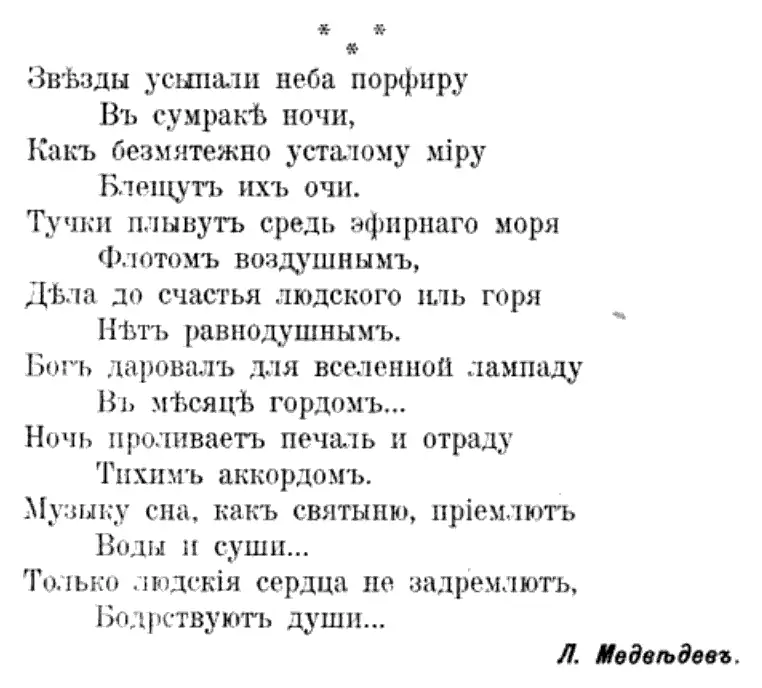
The search used only lines 1 and 2, so the other eight rows of the square are a fair test. In rows 3 to 10 the poem agrees with Sinelnikov’s square in 64 of the 69 cells that the square fills there (Figure 8).Of the five cells where the poem and the square differ, no pair uses 4/5, and the one pair at 5/7 fits neither. At 7/2 three of the four pairs give the poem’s letter. At 7/3 and 10/9 the square’s н and и fit the name «Доноди» (Donodi), which the compilers read themselves, and the и possibly also «Устинью», since the square has no ю. Sinelnikov’s square also gives the eleventh and twelfth letters of rows 3 and 8, е ж and у ш, and they are those of the poem. It shows е and ж in places 11 and 12 of row 2, where the poem has о and ч; the only support for them is one 2/12 in the first copy of an address in no. 200, where the second copy has 3/12.
7/2 Row 7, place 2.
The poem has ѣ, in «Дѣла»; Sinelnikov’s square has а. Four pairs in the letters point at it, and three give the printed letter.
- no. 14 «Марье» 7/2 for а†
- no. 80 «севере» 7/2 for е
- no. 200 «отделение»first copy 7/2 for е
- no. 200 «отделение»second copy 7/2 for е
The edition prints 562 pairs in this key, in nine documents, letters to Bauman and from him.Nos 14, 24, 73, 80, 200, 222, 235, 318 and 336 in vol. 1. Two of them, nos 318 and 336, are police copies of intercepted letters. Of the 555 pairs that can be set against a letter of the edition’s reading, the poem gives that letter for 516, or 93.0%.Of the other seven of the 562, three are printed without their second number, and four have no letter in the printed word. Sinelnikov’s square, built from these very pairs, reads nearly as many, so it is the rows the search never used that identify the poem.Sinelnikov’s square reads 514. It has eleven cells empty and five that differ from the poem. The hard signs count as letters of the line here, as in Tan’s translation, and without them each later letter of a line moves up one place, so that the poem reads only 346. Without the twelfth letters for ж and ш, it gives 510.
516 of 555 pairs give the printed letter (93.0%) over all nine documents, with the poem
pairs giving the printed letter
The project’s controls, each with one thing changed (the poem gives 516): Sinelnikov’s square 514, the poem begun at another line at most 41, hard signs left out 346, without the twelfth letters for ж and ш 510.
Householders in the index
Where the poem and the edition disagree, either may be wrong. Of the 39 pairs that give a letter other than the edition’s, most are likely to be slips of the writer, a copyist or the printer, and nearly half are in one copied document.Of the 39, 18 are in no. 200, seven of them in a row near the start of one of the two copies of an address that it holds. Twenty are single pairs, four of them in no. 80, where the second number is one too high. Two are spellings, «Лепешинскаго» in the old spelling where the edition prints «Лепешинского», and «получении» where it prints «получению», which the square cannot spell, since it has no ю. Three are in the name «Марье», in no. 14, where the pairs 7/2, 9/4 and 5/7 stand over а, р and ь and the poem gives ѣ, ъ and л. Four of the nine documents are copies: nos 318 and 336 police copies, and nos 200 and 235 copies in the Party archive, no. 200 in Blumenfeld’s hand. Where the edition brackets letters in a reading, the pairs can settle them. In no. 222 it prints «З[и]наида Павло[в]на», and the letters it brackets are in the pairs. In no. 235 it prints «Ляп[унова]», as Krupskaya read it, and the pairs printed with it give ляпунов. Seven fall in four readings that the compilers made themselves, and in three of them the pairs spell another word. In no. 24 the compilers print a house at Pskov as «дом Ветровой» (Vetrova’s house), where the pairs read п е т р о в о (Petrova’s house). In no. 14 they print a house at Pokrov as «дом Чапышниной» (Chapyshnina’s house), where the pairs give ч а л ы ш к и н ѣ и, which with one pair changed would be Chalyshkina’s house.With 8/9, which is о, for 8/2, and with и for й, which the square lacks, the pairs would give «Чалышкиной». In no. 24 the й follows the pairs in clear. In no. 73 they print a name as «Доноди» (Donodi), where the pairs read д о л о д (dolod) and then a г (g), which fits nowhere in the reading.
Each may be the compilers’ misreading of the manuscript, or a misprint. The writer may also have slipped, and the compilers put the name right from another source without the note their rules ask for.The rules let the compilers correct an obvious slip without a note, but footnote any part of a text they restored from other sources, addresses and meeting places among them (vol. 1, pp. 23–24). Neither reading of the pairs needs the poem, since the cells concerned are the same in Sinelnikov’s square, and the edition’s readings elsewhere agree with them. Eleven other pairs that point at cell 4/2 are printed as л, eighteen at cell 3/1 as к, and seventeen at cell 5/6 as п. No. 24 is an autograph, so a copyist cannot account for it. In no. 24 the edition prints the first pair of the name as 5/16, which gives п. A 5/19 would give в, from a cell that only the poem fills, so one misprinted digit would make «Ветровой» right. If the pairs are right, two entries in the edition’s index rest on a wrong reading. The index lists «Ветрова — домовладелица в Пскове» and «Чапышнина — домовладелица в Покрове» (householders in Pskov and in Pokrov), and cites each from that reading alone. The manuscripts would settle which reading is right, and a record of who owned the two houses would settle the index.
The address at Pokrov in no. 14 is Babushkin’s, and no. 14 is the letter to Bauman of 5 April 1901. On that day Leman wrote to both men. One letter, in Tan’s translation, told Babushkin how to find Bauman, and the other, in Bauman’s square, told Bauman where Babushkin lived.
Already in print
Every reading here rests on the edition as printed. The pairs come from scans of its three volumes, typed and then checked against the page pair by pair.
Searches of the web, GitHub and Zenodo in Russian and English, the last on 12 October 2026, found no earlier reading of the address, no identification of Bauman’s poem and no key for the letter to Babushkin. They did not reach Uralsky’s book of 1988, which according to Sinelnikov published Iskra keys, or T. A. Soboleva’s histories of Russian ciphers, and they would not find work that exists only in print. Sinelnikov, who cites Uralsky’s book, still lists Lepeshinsky’s pairs as unread, the author of Bauman’s poem as unknown and the key to the letter to Babushkin as not found. Sinelnikov named the key to Lepeshinsky’s letter, and the reading here changes only how it is counted. The edition prints a reading of every passage in Bauman’s key, so the poem adds no new text, and the square Sinelnikov rebuilt could have shown most of the edition’s slips before the poem was found.
London, 1902
Lepeshinsky, who had asked for the address, was abroad in the summer of 1902 but went home without seeing Lenin and Krupskaya, and was arrested in November.The edition’s index has him abroad from 2 July to 18 August 1902, and on 22 August Krupskaya wrote that he had gone home without seeing them (vol. 2, no. 589, p. 165). Her reply to his letter had said she was glad her mother was travelling with him, a sentence she then struck out (no. 450, p. 12), and her mother was with them in London by the end of September. By then Babushkin and Bauman had been arrested, in December 1901 and February 1902, and had both escaped. Bauman was one of the eleven who broke out of the Kiev prison in August 1902. Babushkin reached London in September, and Krupskaya remembered that his dyed hair had turned crimson.
See also
- The ambassador’s cipher: a French ambassador’s cipher of 1558, read with a key rebuilt from the decipherments bound beside his letters
- The cardinal’s cipher: six lines of cipher in a Spanish letter of 1520, read with a published key
- А. В. Синельников, Шифры и революционеры России: the history of the revolutionaries’ ciphers, with the lists of keys found and letters unread that this piece starts from
- N. K. Krupskaya, Reminiscences of Lenin: the chapters on Munich and London, 1901–1903, by the woman who kept the letters
The project
The transcriptions, the key texts, the programs and the numbers quoted here are from the Iskra repository, a release that has not been peer-reviewed, or are counted in the figures from its data. Its check.py recomputes every count quoted on its pages from the key texts and the printed pairs, checks the figures, tables and readings on those pages against what it has computed, and runs the controls. It cannot show that a pair was copied correctly from the edition, or that a date, a page, a quotation or an archival reference is right, and those were checked against the sources by hand. It does not repeat the search over other texts for no. 15, because neither the Wikisource dump nor the collection cut from it is in the repository; the two scripts that made the search are there, with the record of what it printed.
The figures on this page run a port of the project’s three scripts to TypeScript, which prints what the scripts print from the same data, line for line, and the page’s own test checks every count and reading in this text against the data.
Spellings, dates and translations
Russian is quoted in the spelling of its source. The key poems are in the old spelling, as printed: before the reform of 1918 Russian had letters such as ѣ and і, which were dropped, and a hard sign, ъ, at the end of every word that ended in a hard consonant. The edition modernises the letters it prints, and is quoted in its own spelling. The letters that pairs give are in lower case, as the project prints them. The edition dates each letter in the New Style and then in the Old Style in brackets, and letters are dated here in the New Style. Other events in Russia are dated as the sources date them, which is usually in the Old Style, thirteen days behind the New in these years. The English versions of the poems are plain translations, line for line, for sense and not for verse.
The images
Figure 3 is p. 152 of Заря no. 1 (Stuttgart: J. H. W. Dietz Nachf., April 1901), from the scan at the Internet Archive, item zarya-1-1901. Figure 7 is p. 50 of Жизнь, vol. VI (St Petersburg, June 1900), digitized by Google from the copy at Harvard University (Google Books id sYgAAAAAYAAJ). Both are in greyscale and cropped to the text, at the size of the scans. The pages of the 1969 edition are not reproduced, since its notes and readings are still in copyright; its number pairs are quoted in type.
References
- Переписка В. И. Ленина и редакции газеты «Искра» с социал-демократическими организациями в России. 1900–1903 гг., 3 vols, Мысль, Moscow (1969–70), prepared by К. Г. Ляшенко, В. Н. Степанов and З. Н. Тихонова. Cited by volume, document number and page; the index of names is in vol. 3.
- А. В. Синельников, Шифры и революционеры России, Novosibirsk (1980–2000, revised 2009). Appendix 2 lists the identified keys and appendix 4 the letters and keys not yet worked out.
- Нарцисъ Тупорыловъ [Ю. О. Мартов], Гимнъ новѣйшаго русскаго соціалиста (На мотивъ „Варшавянки“), Заря 1, Stuttgart (April 1901), 152–153.
- V. I. Lenin, letter to P. B. Axelrod, 23 April 1902, in Collected Works, vol. 43, Moscow (1977), 81–82.
- Л. Медвѣдевъ, «Звѣзды усыпали неба порфиру…», Жизнь, vol. VI (June 1900), 50. Scan of the volume digitized by Google, Google Books id sYgAAAAAYAAJ.
- Ада Негри, «Fatalità», translated by В. Г. Танъ: «Полночною порой вчера къ моей постели», Russian Wikisource, the page in the old spelling, revision 5004993 (26 August 2023). Wikisource gives its first publication as Начало, 1899, no. 5, 165.
- Вся Москва: адресная и справочная книга на 1901 год, and the volume for 1902, in the electronic library of the State Public Historical Library of Russia.
- Лев Михайлович Медведев, author page on Russian Wikisource.
- Ю. С. Уральский, Пароль: «От Петрова», Moscow (1988). Not seen; according to Sinelnikov, the first publication of the Iskra keys known to its author.
- Т. А. Соболева, Тайнопись в истории России, Moscow (1994), and История шифровального дела в России, Moscow (2002). Not seen; Sinelnikov cites the first for the Police Department’s decipherers.
- N. K. Krupskaya, Reminiscences of Lenin, chapter “Life in London 1902–1903”.
Cite this
@misc{iskra-ciphers,
  author = {Devin O'Keefe},
  title  = {An address and two key poems},
  year   = {2026},
  url    = {https://devinokeefe.com/iskra-ciphers/}
}
Comments