The cardinal’s cipher
In September 1520, with Castile in revolt and Charles V abroad, Adrian of Utrecht, the cardinal governing in his place, sent him six lines in cipher. Both editions of the letter leave them out. The lines mix drawn signs for letters with groups of ordinary letters for words. Adrian later became pope, and Olga Kolosova rebuilt the key of this cipher from the letters he sent Charles from Rome. Four of his letters of 1521 fill its gaps, and with them it reads all six lines. The rebels, he wrote, had turned on the great nobles, whose taxes and towns they meant to take, and this might bring a remedy. Tested on two passages whose decipherments are known, the key gives the same words wherever it has a value, apart from spellings and one word, where a printed decipherment is likely wrong. Two points rest on thin evidence: the group for *remedio*, found in one other letter, and a stroke of the pen that decides whose taxes the rebels meant to take.
In May 1520 Charles, king of Castile and newly elected emperor, sailed for the Low Countries. He was twenty, and he left his old tutor, Adrian of Utrecht, to govern Castile in his place. Adrian was a Netherlander of sixty-one, a cardinal and the bishop of Tortosa, in Catalonia.Charles was born on 24 February 1500 and Adrian on 2 March 1459. In the Cortes the members for Córdoba had protested that he was not a native. By September the towns of Castile were in revolt, and the cardinal was writing to the king from Valladolid about once a week. On 9 September he described the rebels of Plasencia holding back the king’s revenues, and wrote that the king would learn what they were aiming at “from the cipher that goes inside this letter”. Those words are the last in ordinary writing above the six lines of cipher in Figure 1.In Spanish, por la cifra que va dentro desta (Danvila, vol. 2, p. 18). The words could also mean a separate sheet, now missing: the cardinal’s letter of 1 October 1520 uses them of an enclosure. A few lines above, the letter says that the rebels at Plasencia had not only held back the king’s revenues but had taken the money that a tax-farmer’s servant had collected, in the construction no solamente … mas ahun that the six lines use.
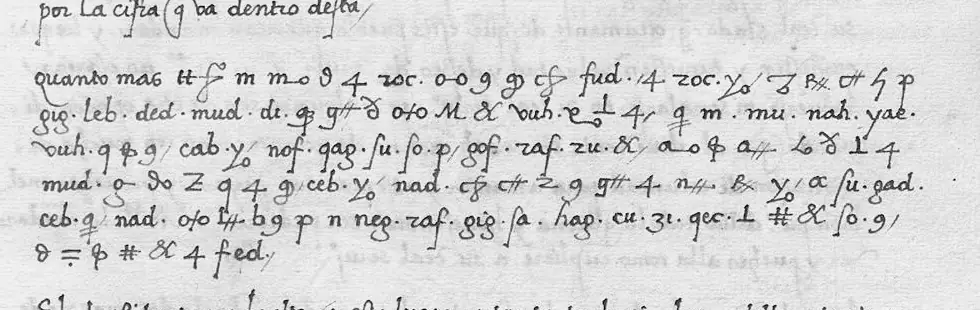
Constantin von Höfler, who printed the letter in Prague in 1881, put in place of the six lines only the Latin Deest (it is missing). Manuel Danvila printed it again in 1898, in his history of the revolt, with a note that a paragraph in cipher followed which “could not be translated”.Danvila’s note reads “(Sigue un párrafo cifrado que no ha podido traducirse, y continúa:)”. By “translated” he meant deciphered. Höfler printed the letter under 8 September. No decipherment is filed with the letter in the archive at Simancas, though the leaf before it holds one. It is of an earlier letter of the cardinal’s, on the risings of June 1520, and is headed “What was taken out of the cipher of the cardinal’s letter”.“Lo que se sacó de la cifra de la carta del Cardenal” (Danvila, vol. 1, p. 373).
The six lines are in a cipher the cardinal’s chancery went on using for years, and Olga Kolosova rebuilt its key from letters he wrote two years later. His letters of 1521 fill its gaps, and with them it reads all six lines. In them the cardinal tells the king that the rebels had turned on the great nobles as well as on the Crown, and that this might bring a remedy.
Against all the great nobles
The six lines read, in the spelling of the cardinal’s letters:Words spelt in letter signs are given as the clerk spelt them. A group carries no spelling, so its word is spelt as the clear text of the letters spells it: ahun and Magestad, where Kolosova has aun and Majestad. The choice between c and ç, u and v, i and y, which the cipher writes with the same signs, is editorial, and so are the capitals, the word division and the two commas.
Quanto mas quiça esto dara remedio a estos males, que no solamente se mueven contra su Magestad mas ahun contra todos los grandes, dels quales entienden primeramente quitar todas las alcavalas y despues todas las villas y lugares que de poco tiempo aca fueron de la corona real.
In English they read:
Perhaps this will bring a remedy to these ills, for they are rising not only against His Majesty but against all the great nobles as well, from whom they mean to take first all the sales taxes and afterwards all the towns and villages that not long ago belonged to the royal Crown.
A clerk, whose name is not known, put the letter into cipher. He wrote the first two words of the six lines, Quanto mas, in ordinary letters, likely as nulls for the reader to pass over, and the English leaves them out. If they belong to the text, the six lines open “All the more since this will perhaps bring a remedy”, and no other word changes.Kolosova calls such words, function words such as como, quanto, pero and quien written in ordinary letters at the head of a passage, this cipher’s only marcadores (markers), not to be read, and adds that their use depends much on the secretary (thesis, p. 229). The usual term is nulls, which Tomokiyo uses and which, he reports, her book of 2024 adopts. In the four letters of 1521 used below such words stand at 15 places, and the deciphered text leaves them out at 12. Eleven of the 12 are in Danvila’s print of two of the letters, however, and the decipherment of a third, made at the time, reads them twice and leaves them out once, at Quanto menos, the nearest in form to quanto mas.
By “this” the cardinal meant what the rebels at Plasencia were doing. Earlier in the same letter he had wished that matters were already at their worst, “so that there might afterwards be hope of improvement”. In a postscript he reminded Charles to have letters written to the great nobles and the prelates, “but not in the same terms”. He likely hoped that the nobles, once the revolt came for their revenues, would side with the king. On the same day, in Brussels, Charles wrote to the Constable of Castile that he had named him and the Admiral of Castile, two of those great nobles, governors alongside the cardinal.Charles’s letter is in Danvila, vol. 2, p. 12, note 2, where Danvila gives it from the chroniclers Argensola and Sandoval. The Constable and the Admiral were both grandees. A royal order of 5 September announced the appointment, and the king’s instructions remitted the grant voted at La Coruña in the spring, one of the revolt’s grievances (pp. 11–12 and 16). The postscript is on p. 19.
The town of Dueñas shows what the great nobles stood to lose. One Sunday night it rose against its lord, the Count of Buendía. On 2 September its new council wrote to Valladolid that the town had been taken from the Crown and given to a lord in breach of a sworn privilege, and that it had risen in the name of the king, of the Crown and of Queen Juana, his mother. Juana had been queen since 1504, but she was held to be mad and kept at Tordesillas, where the rebels’ Junta moved later that month.Danvila, vol. 2, pp. 146–148. Danvila gives the night of the rising only as “la noche de un domingo”, with the new council named the day after; the Junta of the rebel towns answered a complaint about it on 4 September (p. 45). The rising and the revolt’s turn against the lords are treated in Joseph Pérez’s study of the revolt (1970) and in Juan Ignacio Gutiérrez Nieto’s Las Comunidades como movimiento antiseñorial (1973), neither of which was seen. The towns and villages of the six lines were likely those that had passed from the Crown to the nobles in recent years. The alcavalas of the six lines were sales taxes, which belonged to the Crown but in many lordships had passed to the lord by grant or by usurpation.
The great nobles did fight for the king, and the rebels were beaten at Villalar in April 1521. The cardinal came back to the point twice that year. In May he wrote, again in cipher, that the great nobles had served “not only for your service but also for the fear they had of the communes [the rebel towns], for these meant to take their lands from them and bring them back to the Crown”. In August, from Logroño, he passed on the common opinion that they would not have opposed the rebels so readily if the rebels had not set out to harm them, “above all in wanting to take the sales taxes from them”.Danvila, vol. 4, p. 26 (the letter of 23 May 1521, its first cipher paragraph: no solamente por vuestro seruicio mas ahun por temor que ternian a las comunidades ca tenian proposito de tomarles sus tierras y reducirlas a la Corona, with the construction no solamente … mas ahun of the six lines) and p. 379 (Logroño, 14 August 1521: mayormente en quererles quitar las alcaualas, the verb and the noun of the six lines; Danvila does not mark this passage as cipher). These letters show what the cardinal believed about the nobles’ motives; they are no evidence for any value in the key.
Groups that spell nothing
The key gives from one to seven signs for each letter, and the clerk varied among these homophones, so that a common letter need not turn up again and again as the same sign. In the first line he wrote dara with four signs, and its two a’s are different signs, one shaped like a 9 and one like a c and an f joined.
For words the clerk used a code. He wrote a word, or part of one, as a group of two or three ordinary letters closed by a dot: gig. for que, leb. for no, roc. for esto. He added an ending in letter signs or with another group: roc. with an s is estos, qec. (fue) with r, o and n is fueron, and ded. mud. is sola-mente. A group’s letters do not spell its word. Most chanceries of the time wrote in nomenclators like this one, which use an alphabet of signs and a small code together, and their secretaries listed the groups and their words in the code’s vocabulary. Without that list a group cannot be read from its letters.
Thirteen words short
In January 1522, while he was still governing Castile, the cardinal was elected pope, as Adrian VI. From Rome he went on writing to Charles in cipher, and his letters of September 1522 to March 1523 are now in the Real Academia de la Historia in Madrid. Kolosova rebuilt the key of their cipher in her doctoral thesis at the University of Valencia: a table of 65 signs, and a vocabulary of 92 entries.Kolosova, El lenguaje secreto de la diplomacia de Carlos V (1521–1527), title page dated May 2016, usually cited as 2017; the full text is in Teseo, the Spanish ministry’s database of theses. The cipher is her no. 4; the table is on p. 227 and the vocabulary on pp. 249–250. The table’s 65 signs are for 21 letters: one set serves for u and v, one for i, j and y, and one for c and ç. She prints each group as a picture cut from the manuscript, so the letters given to her groups here are a reading of those pictures. Of her 92 entries, 88 are groups; the other four are pairs or a group with letters, such as cim. mu. for vuestra Majestad, from which mu. alone is taken as Magestad. One of her letters, of 22 November 1522, is printed in full, deciphered, in Gachard’s edition of the correspondence of Charles and Adrian (1859, pp. 137–138), as Tomokiyo notes.
Kolosova’s key was made from letters written two years after this one, and it cannot read every word of the six lines. Guess: which words does it miss?
Her key alone reads 33 of the 46 words in cipher in the six lines, so they are in her cipher. They are earlier than anything else yet found in it, the letters of 1521 included.Six weeks before them, on 28 July 1520, the cardinal wrote to Charles in a different cipher, which Mikel García Larragan solved without a key in April 2026. The sources do not show when or why he took up the cipher of the six lines.
- 1
 //
- 2
 /·
- 3
 ////
- 4
 ///
- 5
 //
- 6
 /
italic a value found in the letters of 1521 ? no value with this key dotted underline a point that rests on judgement q1, a2 a sign, named by its letter and a number / the clerk’s word divider
Every sign and group has a value; the values in italic come from the letters of 1521, and the rest from Kolosova’s key.
line 1 remedio
The group fud. is not in Kolosova’s vocabulary. Its value, remedio, comes from the letters of 1521: in letter D, of May 1521, image 5, line 32, the cipher has cog. + d-a-d-e-r-o fud. where the deciphered text has verdadero remedio.
source fud. from letter D
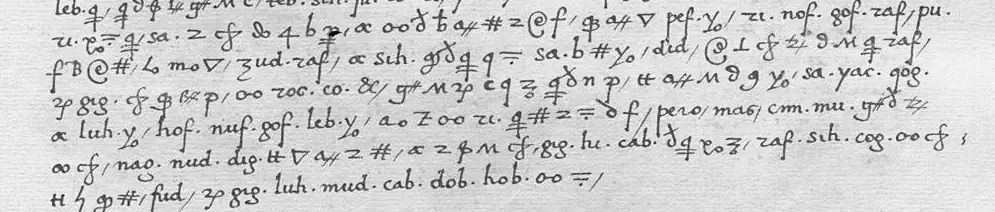
Letter D, image 5, lines 31–32: fud. ringed, and underlined cog. + d-a-d-e-r-o fud., for verdadero remedio.
- the reading
With her key alone the opening reads “this will give … to these ills”. The 13 words it misses include the remedy, the great nobles, and the words that say the rebels meant to take their taxes and towns. Ten of the 29 different groups in the six lines are missing from her vocabulary, and both of their signs for q are missing from her table.
The true remedy
The missing groups turned up in the cardinal’s letters of 1521. In notes posted in September 2026, Dan Bourdeau listed four of the cardinal’s letters of late 1521 as written in one code of dotted groups, and quoted some of its groups. Satoshi Tomokiyo matched those groups with groups in Kolosova’s vocabulary and suggested that the letters were in her cipher too. He writes on the history of ciphers on his site Cryptiana, and he could not find the letters themselves on the Spanish archives’ website.Tomokiyo’s section is dated 24 September 2026. Bourdeau’s notes, posted on 18 September and revised on 30 September, are about the governors’ joint letter of 30 December 1521, which is in another cipher; they call the code of the cardinal’s letters a “dotted trigraph code”. All four are there. The three of December are written in her signs and groups, and a sheet filed with one of them holds the cipher of the fourth, of 24 October, in the same signs and groups.
In May 1521, a few weeks after Villalar, the cardinal begged Charles to come home:
V. M.at venga luego le suplico y crea que para todo este es el verdadero remedio, otramente todo seria perdido.
He was asking the king to come at once, and to believe that this was the true remedy for everything, without which all would be lost. With a letter of 23 May he sent Charles duplicates of earlier letters, and a copy of his letter of 6 May, likely one of them, has the sentence in cipher. Danvila prints it deciphered in the letter of 23 May. Where Danvila prints verdadero remedio, the cipher has the group for ver, the letters d, a, d, e, r, o, and fud., so fud. is remedio, as in the six lines. Right after fud., though, the cipher has a letter sign and gig. (que) that Danvila’s print does not have, so cipher and print are not quite in step there. The group for ver, the letters before fud. and its place in the order of the vocabulary (below) still put remedio there, but the value rests on this one place and on a decipherment whose maker Danvila does not name.
The key’s additions come from documents of 1521 whose deciphered text survives: the letter of 5 December, one of the two of 7 December, the sheet with the cipher of 24 October, and the copy of 6 May, which Bourdeau’s notes do not list. The first two were deciphered at the time, and the decipherments are filed with them; for the other two, Danvila printed the deciphered text. With its deciphered text beside it, a passage of cipher shows which group stands for which word. The words spelt out in letter signs keep the two texts in step every few groups, and the deciphered text supplies the words that the groups between them must stand for.The four, labelled A to D in the project’s pages and in Figure 2: A, 5 December 1521, with its decipherment of the time; B, a sheet wholly in cipher filed with a letter of 7 December 1521 and holding the cipher of the letter of 24 October 1521, whose deciphered text Danvila prints (vol. 4, pp. 547–549), noting elsewhere that the sheet’s decipherment might belong to one of the cardinal’s earlier letters (p. 685); C, 7 December 1521, with its decipherment of the time; D, a paragraph written into a copy of the letter of 6 May 1521, whose deciphered text Danvila prints in the letter of 23 May (vol. 4, pp. 28–29).
In all, the letters of 1521 add 63 groups to Kolosova’s vocabulary, among them the ten that the six lines need.A group was given a value only where the deciphered text, known plaintext in a codebreaker’s terms, sets it against a word, or part of a word. Besides fud. for remedio, ded. stands where the text has sola, in en una sola cosa; cu. stands three times for tiempo; and ru. with an n three times for entienden. Letter A writes corona real as six letter signs and fed., as the six lines end. The key is still partial: it holds only the groups that occur in the letters read. The appendix describes a check of the alignment at 29 points. The values of three of the ten, fud., ded. and neg., each rest on a single place in those letters.In the six lines ded. and neg. each join the group beside them to make a familiar word, sola-mente and lugar-es. The letters of 1521 also hold two signs for q. One begins quatro, quinientos and quiteme in those letters and quiça in the six lines. The other begins quitaciones in the letters and quitar in the six lines. A second transcription of the six lines, made for the project from enlargements without sight of the first or of the letters of 1521, has the same sign or group at 111 of the 112 places; the appendix gives its conditions.
The cipher and most of the key are Kolosova’s. The project Adrian1520 gives the reading word by word, with the source of every value. The searches of October 2026 found no earlier reading of the six lines, no earlier statement that they are in her cipher, and none of the values that the letters of 1521 add to her key.Two of the 63 added groups, those for tiene and ver, stand in the October passage (below), so the value of ver is implicit in both its printed decipherments, and that of tiene in the one of 1898.
A loop or a straight stem
Five points in the reading rest on judgement, and the one that matters most is a single stroke of the pen. The clerk wrote q with a straight stem and g with its tail closed in a loop, like a figure of eight, and in the third line qag., the group for gran, has both (Figure 3). Three groups later comes gof., with the loop. It is the group for qual, in dels quales entienden (from whom they mean). With a straight stem it would be qof., which stands four times for gouernadores in the cipher of the letter of 24 October 1521, each time with the stem. The line would then say that the rebels meant to take the sales taxes from the governors.
The clerk of that sheet kept the two groups apart. On the line between two of its places for qof., gof. stands for qual with the loop, as it does again in the copy of 6 May. Those two places were found after the key had been fixed, and they show the distinction in the letters of 1521, not in the hand of the six lines. The second transcription of the six lines also has the loop.

gof. closes in a loop, like the g of qag., so the line names the great nobles as those whose taxes the rebels meant to take. Line 3 of the six lines, enlarged three times. The loop is a judgement from the image; no check run on the key or the transcriptions can decide it. Archivo General de Simancas, PTR,LEG,2,1,19, image 1, from PARES.The other four points that rest on judgement are smaller: at each the reading follows forms written elsewhere in this cipher, or no word turns on it.An m without its usual bar, read as a t, would make priteramente, and letter A begins mil twice with the same barless m, where its decipherment has mil. A blotted o, read as an a, would turn the group for esto into the one Kolosova gives for both embajador and esta; it is read like the unblotted roc. later in the same line. The first sign of quiça, a p joined by one bar to a tall long s with a ring, might be two signs, and at four places in the letters of 1521 the deciphered text shows it standing for q. A dot in the second line belongs to no group. Three other things are unexplained, and none changes the reading. Here mu. alone means Magestad, as it does nowhere in the letters of 1521. The six lines name the king in the third person, su Magestad, where the rest of the letter addresses him as Your Majesty or Your Highness; the nearest it comes is after the date, with su real stado and a su real servicio. The clerk wrote dels, the group for del with an s, where the letter of 7 December 1521 has de los. Either an o is missing there, or dels is the Catalan form: the letter’s ordinary writing has ciudat and verdat, with the final t of Aragonese and older Castilian.
From z back to b
The code runs backwards through the alphabet, and its order gives fud., ded. and neg. a check of their own. The first letters of its groups run z y x v t s r q p n m l h g f d c b, while their words run forwards from a to y: words in a take groups in z and y, words in d take groups in s, and ya, near the end of the alphabet, is bu. (Figure 4). Kolosova notes that the chancery’s secretaries compiled such vocabularies in the alphabetical order of their words, so that the first letter of a group can show the first letter of its word. Other ciphers of Charles’s chancery assign their groups from z backwards too.Kolosova, thesis, pp. 241, 243 and 248, and for the cipher of Lope Hurtado, the shorter version of the thesis. A code whose groups follow the order of its words is called a one-part code, since one list serves both to put words into code and to read them. Tomokiyo gives much the same backward order of first letters for two more of her ciphers, her nos 9 and 11. The order is loose where one first letter gives way to the next: ahun, al and assi have groups in y, while algun and antes have groups in z. So it gives no group its value, and apart from supporting the reading of mu. alone as Magestad, no value in the key was taken from it.
fud. is remedio, one of the ten groups the six lines need, from letter D (May 1521). Among Kolosova’s groups in f- it falls between fuf. (re) and foh. (sabe). The groups in f- stand for words from razon to sabe; in the row above, the groups in g-, for words from presta to quisie, and in the row below, the groups in d-, for words from se to tene.
z to b, the rows: each group’s first letter a to y, along the foot: the first letter of the group’s wordThe order narrows a group’s word to a stretch of the alphabet, and it tests these three most sharply. Kolosova’s own groups come from the letters of 1522 and 1523, so they had no part in giving these three their values. fud. begins with f, as do her groups for re and sabe, and remedio falls between those words; ded. begins with d, as do hers for sin and son, and sola falls between them; neg. begins with n, as do hers for los and mas, and lugar falls between them. The order cannot tell remedio from any other word between re and sabe. Two of her own groups break the order, those for deve and so, either because the order was not kept there or because the reading of her pictures of them, cut from the manuscript, has their first letters wrong.
A key spoiled on purpose
Two passages whose deciphered text is known test the key, since neither was used to build it. The first is on the first page of the cardinal’s letter of 7 December 1521. The key’s values from that letter all come from its second page, and the passage was transcribed only after the key was settled. The key has 31 of the passage’s 35 groups, and every one of them gives the word of the decipherment.The 31 are 19 different groups, 16 of them Kolosova’s and three added from the letters of 1521. The four groups the key lacks are daf., tib., bab. and dah., where the decipherment has scrivi, conviene, yo (in danyoso) and tan. The key also matches 90 of the passage’s 93 letter signs to a sign of the table, and all 90 give the decipherment’s letter. Of the other three, two are not in Kolosova’s table and one could be either of two signs that look alike. At three places the clerk spelt more briefly than the decipherer, once leaving out a letter that changes the word (dello for dellos). Most of those groups are Kolosova’s, from the letters of 1522 and 1523, so her values already held in 1521.
The second is from the cardinal’s letter of 8 October 1520, a month after the six lines. He added it once the first part of the letter was written. Danvila printed it deciphered in 1898, and credited the decipherment to Claudio Pérez y Gredilla, who ran the archive at Simancas. The key reads 20 of its 22 words in cipher, and at 16 of them it gives Pérez y Gredilla’s word, letter for letter (Figure 5). At one of the other four the clerk of that passage wrote the group for la, so that the phrase reads por la que va con esta (by the one that goes with this). La fits a letter sent with this one, since carta is feminine, and the cardinal’s letter of 23 May uses the same words of a letter sent with it, en la que va con esta. His reading as Danvila printed it has lo, and the key is likely right.Two of the other differences are spellings: the key gives marichal and Hernando where the print has Mariscal and Fernando; Hernando was a common form of the name at the time, and marichal may be a form of mariscal or a slip. At the fourth the clerk was saving signs: he wrote tienente, the group for tiene followed by n, t and e, and spelt Teniente in full a line later. The two words the key cannot read are Navarra, written with a group not in the key, and the second Teniente, spelt out with a form of t that is not in Kolosova’s table. One of the 16, esta, agrees in its letters only: the clerk wrote Kolosova’s group for the verb está. Gustav Bergenroth’s reading of 1868 (below) also has la, and Herdando, a misprint for Hernando; but earlier in the same passage he prints la where the letter’s ordinary writing has lo, so his la counts for little.
- 7 December 1521 31 groups in the key and 90 signs matched in the table; none disagrees with the decipherment
- 8 October 1520 20 of 22 words read: 16 the printed word, 4 the differences discussed in the text
- the six lines of 1520 (no test) the key gives the letters of the reading
- 1 Lo que daf. ? scrivimih. mos mos/ a4 a acim. vuestra vuestramu. Magestad magestadso. del dela1 a avuh. con conc2 c ce4 e es2 s si1 i io3 o on3 n nso. del delo1 o os4 s s/ c1 c ca4 a ap1 p pi6 i i
- 2 t2 t tu1 u unof. los los/ o1 o op3 p pa3 a ar1 r rt1 t te1 e ed2 d dsoh. ello elloa2 a an2 n nt2 t te3 e es1 s su1 u uu2 u ve2 e en1 n ni4 i id3 d da2 a aleb. no nomef. me mep2 p pa3 a a
- 3 r3 r re4 e ec1 c ce3 e egig. que quetib. ? conviene
- 4 c2 c ca4 a a/ o3 o ot1 t to1 o or3 r rg1 g ga2 a an2 n nsae. do do/ cab. todo todos4 s s/ nof. los los/ c1 c ca3 a ap1 p pi6 i it2 t tu3 u unof. los los/ dob. seria seriad2 d da2 a an2 n nbab. ? yos1 s so3 o o/
- 5 a4 a acim. vuestra vuestramu. Magestad magestadi2 i yvuh. con conc2 c ce2 e ep1|d3 p or d di6 i iri. en ensae. do do/ dah. ? tanded. sola solamud. mente mente/ p1 p pa3 a ar3 r rt1 t te1 e e/ d2 d dsoh. ello ellos4 s s/
- 6 seh. el elp1 p pu3 u ue1 e eX1 ? bl1 l lo4 o o/ di. se sevuh. con cont1 t tri. en enX2 ? ta3 a ar1 r ri6 i ia2 a a/ hag. poco pocori. en ena2 a au1 u us4 s sri. en enc3 c ci1 i ia1 a a/
Code groups: 35, of which 31 are in the key and 31 give the word of the decipherment. Letter signs: 93, of which 90 can each be matched to one sign of the table and 90 agree; one sign could be either of two, and the pair includes the decipherment’s letter. Not in the key: daf. tib. bab. dah. X1 X2.
a4 a sign, named by its letter and a number/ the clerk’s word dividerWith the key spoiled on purpose the tests can fail (Figure 5). Swap an a and an o and the December passage disagrees with its decipherment at nine signs; read poco as mucho and it fails wherever that group occurs. Read remedio as respuesta, though, and both tests still pass.
fud. is in neither passage, and rests on its one place in the copy of 6 May.The October passage does bear on the copy of 6 May. Its group for ver, whose value also comes from that copy alone, gives the ver of Pérez y Gredilla’s vera, which supports the alignment of cipher and text there. The tests reach ded., but none of the other nine groups her key lacks and neither sign for q. Those rest on the letters of 1521 alone. The decipherment of each test passage lay open beside the images during its transcription, and where two signs, or two letters in a group, look alike, the decipherment may have guided the choice. The agreement of the letter signs is therefore not independent of it, and nor is the choice between look-alike letters in a group.Besides g and q, the r that begins the groups for words in e is shaped like a 2 and is easily taken for z, which in this hand has a tail and looks like a 3. The i has no dot, so ri. (en) and ru. (entiende) differ by one short stroke. The appendix sets out what changed in the key after the first test.
Other letters would test the reading further. The historian Gustav Bergenroth, in a volume of 1868, describes the cardinal’s letters of 13 and 17 November 1520 as deciphered at the time. They are filed in the same bundle as the six lines, and the decipherment he prints of the second has qual, the word of gof., twice. If the letters are in this cipher, they will show its g and q two months after the six lines.Bergenroth, Supplement, nos 69 and 71, citing Comunidades de Castilla, leg. 2, fols 169–171; neither letter has been examined. The letter of 24 October 1521 itself and the decipherment that the catalogue gives for it, PTR,LEG,2,1,94 and 92, would test the straight stem of qof. on the words it rests on, and the letter from Vitoria of 7 December 1521 has five lines of cipher with a decipherment in the margin; none of these has been read against the key. A decipherment of the six lines was likely made for Charles in 1520 too, as one was for the earlier letter on the leaf before them. At court the secretary Francisco de los Cobos deciphered the cardinal’s letter of 22 January 1521, and a paragraph of his letter of 18 September 1521, deciphered for the emperor to read, is now among the papers of state (Bergenroth, Supplement, nos 81 and 95). Danvila printed the letter of 23 May, with the verdadero remedio sentence, from a manuscript with paragraphs in cipher, which may have fud. again.Danvila, vol. 4, pp. 26 and 28–29, citing Comunidades de Castilla, leg. 5, fols 398–401, a manuscript he calls en parte cifrada; the sentence is in the third of the letter’s paragraphs marked as cipher. The manuscript has not been examined.
“Could not be translated”
Danvila printed Pérez y Gredilla’s decipherment of the October passage in the same volume as the September letter, and gave no reason why the six lines could not be translated. They give too little to count, the usual way into a cipher: their 74 letter signs are of 39 different shapes, so most occur once or twice. The two passages are made differently. The October passage spells names and titles such as Hernando, Vega, Simancas and Teniente in letter signs, and a reader who knew the business of the letter could start from them as probable words. Its groups, apart from one for Navarra, stand for short common words such as de, que and por. A reader who had worked out the October passage would have known 56 of the 74 letter signs in the six lines but only four of their 29 different groups. Such a reader could have spelt contra and mueven, but the sense of the six lines lay in the groups.The 56 signs are of 25 of the 39 different shapes in the six lines. With them and the four groups such a reader could spell in full a, que, mueven, contra, dels, y, de and de la, and most of the letters of dara, males, alcavalas and corona.
Pérez y Gredilla let gaps stand in another of his decipherments. In the governors’ joint letter of 30 December 1521, which is in a different cipher, Danvila prints as they stand in the original the words that the archivist could not read.Danvila, vol. 4, pp. 703–705, with a note that, for all his special competence, the archivist could not decipher some words. Danvila adds that Pérez y Gredilla had written a study of the keys, on which the Real Academia de la Historia had reported favourably.Danvila, vol. 2, pp. 251–252, note 4. Of the six lines Danvila printed no reading at all, though the archive that Pérez y Gredilla ran held the letters of 1521 that fill the key’s gaps.
Thirty years earlier, in 1868, Bergenroth had printed the October passage with most of its words in cipher read, “deciphered by the Editor”.Bergenroth, Supplement, no. 64, pp. 261–266; his italics leave out three of the 22 words in cipher and give vea for tiene. From 1860 he had worked through the papers at Simancas that concern England, summarising them in English for the British government and breaking their ciphers as he went.Bergenroth, Calendar, vol. 1 (1862), introduction, pp. xi–xiii. By 1862 he had formed about twenty keys, and the Spanish government’s one condition had been that he leave copies of all his decipherings and keys in the archive. Those keys were for the despatches of Henry VII’s reign. Whether he had a key to the cardinal’s cipher, or read the October passage from its business and its letter signs, is not known; neither his papers in London nor the copies of his keys that he undertook to leave at Simancas were seen. Most of the papers in his volume of 1868 concern Queen Juana. He printed three of the cardinal’s letters of that September, which speak of her.The letters of 4, 14 and 23 September 1520, his nos 55, 57 and 60. He left out the letter of the 9th, whose ordinary writing never mentions her, and with it the six lines of cipher.
See also
- The ambassador’s cipher: a French ambassador’s letters of 1558, whose decipherments, bound beside them, give a key that reads part of the one letter left without a decipherment
- An address and two key poems: the cipher letters of the newspaper Iskra, 1901–1902
- S. Tomokiyo, Scholarly studies on ciphers in the reign of Emperor Charles V, Cryptiana: Kolosova’s ciphers listed and described, with the suggestion that carried this one back to 1521
- M. García Larragan, Criptoanálisis a una carta cifrada del cardenal de Tortosa (2026): the cardinal’s letter of 28 July 1520, in another cipher, solved without a key
The readings and the tests in detail
The second transcription. A second transcription of the six lines was made for the project from enlargements, with Kolosova’s table but without the letters of 1521 or sight of the first. It has the same sign or group as the first at 111 of the 112 places, though not every agreement is independent: two groups of the first were corrected from it. At the one place where they differ it splits the first sign of quiça into a p and an o, which gives pouica, not a word. Asked afterwards what the ten missing groups meant, its reader proposed for nine of them the words that the letters of 1521 give, two of these, remedio and qual, as guesses at 50 per cent or less. That shows only that the values fit the sense. For the first word in cipher the reader proposed publica.
The alignment questions. Another reader, given strips of the passages of 1521 with their deciphered text but neither the key nor the six lines, was asked at 29 points, chosen for the project, which signs or groups stand for a given word. Of the 29, 25 concern groups of the key, at 27 places, and at each place the reader found the groups that the key reads as that word. That reader had the deciphered text in view, so the answers check only that cipher and text were aligned rightly at those points.
Changes to the key after the first test. The key was settled before the first test was transcribed and changed in small ways after it. No group changed its word: 23 groups were respelt, four were removed, Kolosova’s group for Genova was entered again with its first letter corrected, two added groups lost a mark of doubt, and a second place was found for gad.. None of the groups removed, entered again or freed of a mark of doubt is in the six lines or in either test passage. The second test was run only on the key as it now stands. The project’s repository has no history that could show the order of the work, so for that order there is only the project’s own account.
The project
The transcriptions, the added values, the reading and the program behind the figures are from Adrian1520, the project behind this piece, a working release that has not been peer-reviewed. Its pages give the reading word by word with the source of every value, the five places that rest on judgement, and the checks, which its program runs from the data. A pass of those checks shows only that the key, the transcriptions and the reading agree with one another; whether a sign was transcribed rightly can be judged only from the images. The program behind the figures is a port of the project’s own: on the project’s data it prints the same results as the original, line for line, and it runs those of the original’s checks that need only the data. The cipher and most of the key are Kolosova’s: the signs and groups taken from her thesis are hers, and neither of the project’s licences covers them.
The searches of 11 and 12 October 2026 covered the web and GitHub for the shelfmark, the archive’s number and phrases of the reading; the machine-read text, poor in places, of Höfler’s edition and of all six volumes of Danvila; Bergenroth’s Supplement; Kolosova’s thesis; Tomokiyo’s pages and his list of unsolved ciphers; Bourdeau’s notes and catalogue; García Larragan’s blog; and Zenodo. They found no published reading of the six lines. Pérez y Gredilla’s study of the keys, the Academy’s report on it, Kolosova’s book of 2024 and the histories of Pérez (1970) and Gutiérrez Nieto (1973) were not seen. Manuscript catalogues and unpublished work were not searched, and a historian quoting the six lines from the original would not have been found.
The images
All the images are greyscale crops from PARES, the Spanish state archives’ website: España, Ministerio de Cultura, Archivo General de Simancas, PTR,LEG,2,1,19 (Figures 1 to 3), and PTR,LEG,2,1,76, 99, 100 and 101 (the lines from the letters of 1521 in Figure 2). The archive’s record notes limits on reproduction without saying what they are; the images are shown here as public-domain documents, with their source. Every transcription in the project was made from the archive’s images, which are about 1,200 pixels wide, without sight of the original.
References
- Simancas, Archivo General, Patronato Real, leg. 2, PTR,LEG,2,1,19: the cardinal of Tortosa to Charles V, Valladolid, 9 September 1520. Six images on PARES; the paragraph is on the first. Cited by Danvila as Comunidades de Castilla, leg. 2, fols 157–158.
- PTR,LEG,2,1,99: the cardinal to Charles V, 5 December 1521, with the decipherment made at the time (letter A).
- PTR,LEG,2,1,100: the cardinal to Charles V, Vitoria, 7 December 1521, with enclosures, among them an undated sheet wholly in cipher (letter B).
- PTR,LEG,2,1,101: the cardinal to Charles V, 7 December 1521, with the decipherment made at the time (letter C, and the first test).
- PTR,LEG,2,1,76: catalogued as the cardinal to Charles V, 6 May 1521. A sheet marked Duplicadas, copying his letters of 1 and 6 May 1521, with a cipher paragraph written into the second (letter D).
- PTR,LEG,2,1,23: the cardinal to Charles V, Valladolid, 8 October 1520, with cipher words in a paragraph added after the first part was written (the second test).
- C. von Höfler, Monumenta Hispanica I: Correspondenz des Gobernadors von Castilien, Grossinquisitors von Spanien, Cardinals von Tortosa, Adrian von Utrecht mit Kaiser Karl V. im Jahre 1520, Abhandlungen der königlich böhmischen Gesellschaft der Wissenschaften, 6th series, 10, Prague (1881). The letter is no. XXIII, pp. 43–45, under the date 8 September.
- M. Danvila y Collado, Historia crítica y documentada de las Comunidades de Castilla, vol. 1, Memorial Histórico Español 35, Madrid (1897), p. 373; vol. 2, Memorial Histórico Español 36, Madrid (1898), pp. 11–12 and 16 (the governors), 17–19 (the letter), 45 and 146–148 (Dueñas), 251–252 (the letter of 8 October 1520); vol. 4, Memorial Histórico Español 38, Madrid (1898), pp. 26–29 (the letter of 23 May 1521), 379 (Logroño, 14 August 1521), 547–549 (the letter of 24 October 1521), 685 (the sheet filed with the letter from Vitoria) and 703–705 (the governors’ letter of 30 December 1521).
- G. A. Bergenroth, Supplement to Volume I and Volume II of Letters, Despatches, and State Papers relating to the Negotiations between England and Spain, London (1868). It prints the cardinal’s letters of 4, 14 and 23 September 1520 (nos 55, 57 and 60) and passes over the one of the 9th; its no. 64, pp. 261–266, is the letter of 8 October 1520, with the words in cipher “deciphered by the Editor”; nos 69 and 71 are the letters of 13 and 17 November 1520, no. 81 the letter of 22 January 1521, and no. 95 a paragraph deciphered for the emperor.
- G. A. Bergenroth, Calendar of Letters, Despatches, and State Papers relating to the Negotiations between England and Spain, vol. 1, London (1862), introduction, pp. xi–xiii.
- L.-P. Gachard, Correspondance de Charles-Quint et d’Adrien VI, Brussels (1859), pp. 137–138: the letter of 22 November 1522, deciphered.
- O. Kolosova, El lenguaje secreto de la diplomacia de Carlos V (1521–1527), doctoral thesis, Universitat de València (title page dated May 2016; usually cited as 2017). The full text is in Teseo. The cipher is her no. 4: table of signs p. 227, words in clear p. 229, the first letters of its groups and the order of such vocabularies pp. 241, 243 and 248, vocabulary pp. 249–250.
- O. Kolosova, the same thesis in a shorter version, with the same title page, in RODERIC, the University of Valencia’s repository. Its pages are not numbered.
- O. Kolosova, El lenguaje cifrado en tiempos de Carlos V (1521–1527), Ediciones Universidad de Salamanca (2024). Not seen.
- S. Tomokiyo, Scholarly studies on ciphers in the reign of Emperor Charles V, Cryptiana, section dated 24 September 2026.
- D. Bourdeau, cyphersolver: notes on the governors’ joint letter of 30 December 1521 (targets/adrian1521/NOTES.md, and the write-up docs/adrian1521.html, posted 18 September and revised 30 September 2026).
- M. García Larragan, Criptoanálisis a una carta cifrada del cardenal de Tortosa, four posts, 2–6 April 2026: the cardinal’s letter of 28 July 1520, in a different cipher.
- J. Pérez, La révolution des « Comunidades » de Castille (1520–1521), Bordeaux (1970). Not seen.
- J. I. Gutiérrez Nieto, Las Comunidades como movimiento antiseñorial, Barcelona (1973). Not seen.
Cite this
@misc{adrian-cipher,
  author = {Devin O'Keefe},
  title  = {The cardinal’s cipher},
  year   = {2026},
  url    = {https://devinokeefe.com/adrian-cipher/}
}
Comments